Introduction
Makra is a memory layer between the web and AI agents.
It gives your agents a way to read the web the same way a human researcher would — by understanding a page's structure, knowing what data lives where, and returning only what was asked for. Instead of dumping raw HTML into a context window and hoping an LLM can make sense of it, Makra returns clean, structured JSON that your agent can act on immediately.
The problem Makra solves
When an AI agent needs data from the web, the most common approach is to fetch a page, pass its full content to a language model, and ask it to extract what's relevant. This works — but it's wasteful in a way that compounds quickly.
Every request is treated as if the page has never been seen before. The same product listing page, visited a hundred times across a batch job, runs a hundred full inference passes. The same GitHub profile, queried by different agents on different days, is understood from scratch each time.
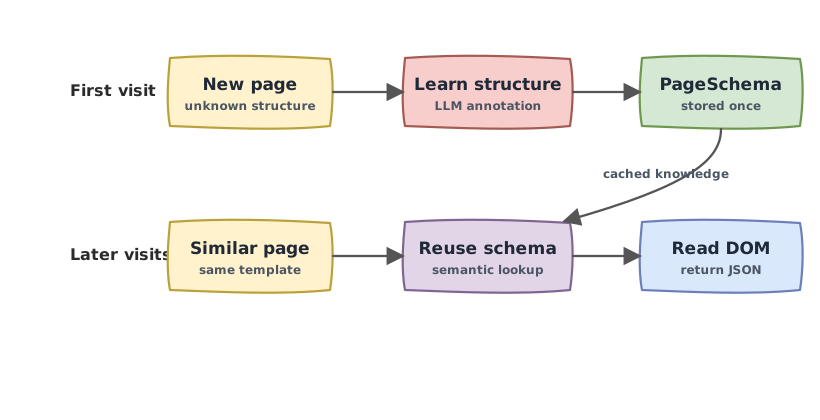
Makra introduces a different model: learn the structure of a page once, and reuse that knowledge indefinitely. The cost of understanding a page is paid on the first visit and amortized across every request that follows. At scale, this brings the per-request cost of web extraction close to that of a simple embeddings lookup — not a full LLM inference pass.
Who Makra is built for
Makra is built for AI engineers building agents and pipelines that need to interact with live web data.
It's the right tool if you are:
- Building an agent that queries websites as part of its reasoning loop and want to keep input token usage low
- Running batch extraction across many pages from the same site and want LLM costs that don't scale linearly with page count
- Writing an agentic scraper that should be intelligent — able to navigate and paginate autonomously — but run at a cost close to a traditional rule-based scraper
How it works at a glance
Makra exposes two APIs. Together, they handle everything from page discovery to structured data extraction.
| API | What it does |
|---|---|
schema | Analyzes a webpage and returns a JSON Schema describing its full structure — every data field the page contains, with semantic descriptions |
extract | Extracts specific data from a webpage, given a JSON Schema describing what you want. Returns structured JSON matching your schema exactly |
On the first visit to any page, Makra learns its structure and stores it. On every visit after, extraction runs without any LLM inference — just semantic lookup and direct DOM reading. The more Makra is used on a site, the more efficient it becomes.
Next steps
- Quickstart — install the SDK and run your first extraction in minutes
- How Makra Works — understand the memoization model that makes Makra efficient
- API Reference — full reference for the
schemaandextractAPIs - Using Makra with AI Agents — wrap Makra as a LangChain tool and build an agent that reads the web